
Interview with Philia
EXTRACT from PHILIA
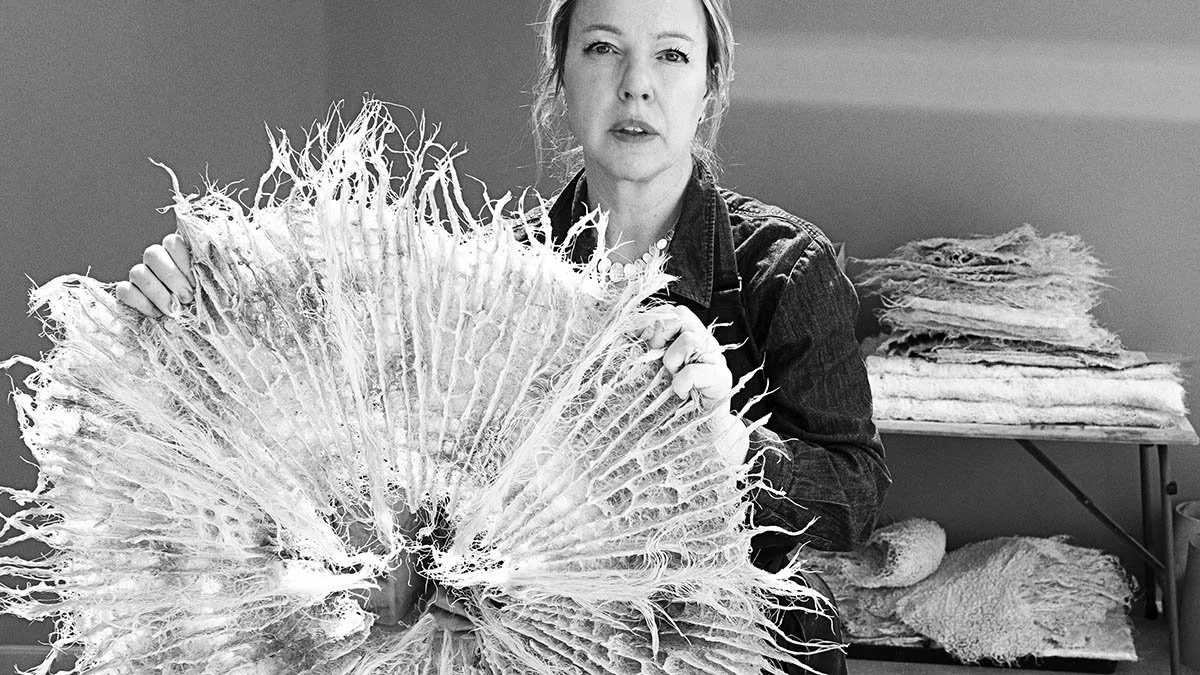
Zena Holloway is a British bio-designer and founder of Rootfull, a London-based studio exploring the intersection of nature, craft, and material innovation. Her practice centers on cultivating plant roots into sculptural lighting and objects, allowing organic systems to shape form over time and positioning nature as both collaborator and maker.
Holloway’s career began underwater. At 18, she left London to train as a scuba diving instructor, later working in Egypt and the Cayman Islands. A self-taught photographer, she spent over two decades capturing underwater imagery for publications including National Geographic, GQ, and The Sunday Times, while directing campaigns for brands such as Nike, Sony, and Greenpeace.
Her transition into bio-design was shaped by firsthand exposure to environmental degradation in marine ecosystems. Through Rootfull, she developed a method of guiding plant root growth using beeswax templates, merging traditional craft with biological processes. Her work has been exhibited internationally, including at the Victoria and Albert Museum and the London Design Festival, and has been recognized with awards such as the QEST Craft Scholarship and a UK Innovate grant.
1. Where were you born and where are you from ?
I was born in Bahrain and have travelled widely; however, London has always been my home.
2. What is your first memory connected to the art world ?
My first “art” memories aren’t from a gallery, but from the water. I’ve had an extensive career as an underwater photographer, so my aesthetic sensibility has been shaped by that weightless and silent underwater world.
3. Have you always worked in the art/design field ?
I have always worked in a creative space, though my “tools” have changed dramatically. As an underwater photographer, the camera lens captured light and movement. Now, with Rootfull, I’ve moved from the darkroom to the grow-room, and I collaborate with living plant root systems.
4. What led you to the design creation ?
Having spent decades underwater, I witnessed the devastating increase in plastic pollution in our oceans. I felt there were solutions in the material choices that we make, so I built a fungarium in my basement to explore mycelium and bio-design. That curiosity led me to research the complex, woven structure of willow roots growing in a local river – it looked like a textile. I imagined that it was possible to grow plant roots into functional materials and create sculptural objects. Seven years and hundreds of tests later, that is now possible.
5. How would you describe your creative process and it influences ?
My process is a kind of biological render that reveals the underground growth of plant roots. It begins with carving templates from beeswax, which often mimic the organic structures of corals or the porous textures of sea sponges. I then sowed wheatgrass seeds onto these templates. Over a 12-day cycle, the roots search out the carved paths, like a maze, weaving themselves into a solid textile. My primary influence is biomimicry—I look at how nature solves structural problems. I don’t force the roots into a shape; I provide a framework and let the biological intelligence of the plant do the “weaving.” It’s a slow, meditative collaboration where the final outcome is never 100% under my control.
6. Could you describe a typical day of your work ?
A typical day follows the rhythm of planting and harvesting rather than an office schedule:
The first thing I do is visit the grow room. Because I work with living organisms, I have to monitor temperature, humidity, and water levels. The roots are incredibly sensitive; a few degrees of difference can change the density of the weave.
Much of my day is spent “sculpting” the negative space of templates. I use beeswax to create the templates that the roots will eventually fill. This is the most labour-intensive part of the design phase.
Every 12 days, the planting cycle ends, and it’s harvest day, when the fully grown pieces are set out to dry, and new seeds are planted. There’s a lot of washing down of decks and a fair amount of fussing and planning to accurately position the new templates.
I also spend time photographing the growth stages — recording the failures is just as important as the successes; it’s where I learn.
7. Why did you choose the specific materials you work with ?
I work primarily with wheatgrass seed and beeswax. Most grasses are fast-growing and produce good root materials, but my preference is for local, organic wheat seed. I use beeswax to carve the templates that guide the growth; discovering this material for templating was a Eureka moment and gave me exquisite control of the root systems without having to use plastics. I choose materials for their honesty and circularity.
8. What are the technical particularities of your creations ?
My process is a slow-tech, biological form of 3D printing. I start with wheatgrass seeds, which contain all the nutrients needed for their first 14 days of life. The roots “weave” themselves into the templates, creating a naturally bound textile. Once harvested, the material is washed and dried. At this stage, it transforms from a heavy, damp mass into a featherweight botanical skeleton.
I finish the pieces with natural waxes and oils to manipulate their flexibility—some remain as delicate lace wall pieces, while others become rigid enough for lighting and vessel structures. For colour, I use natural dyes: madder for reds, gallnut for blacks, weld for yellow, and chlorophyllin for greens.
It’s craft at its most elemental—a collaboration between human design and living systems. I hope that the objects are not merely sustainable, but help to restore our “material literacy.”
9. What advice would you give to emerging artists starting out in sculptural design ?
In the early stages, when my processes were very messy and exploratory, I used only objects and materials that were to hand. Initial template prototypes incorporated items such as my son’s Lego bricks and standard household pots. My advice to artists who are starting out would be to search out local materials in their area.
Keep it small and inexpensive until you’re sure of your process and where you’re going. Remember that Nature will always be the most superior collaborator — she has 3.8 billion years of successful research and development already bagged.
10. If your works had to belong to a design movement, in which one would you define it ?
I would define it as Bio-design or Regenerative Design. The works sit at the intersection where human invention meets biological intelligence.
11. What designers and artists have influenced you ?
My foundations are somewhat unconventional for a designer. As a photographer, I was influenced by the 20th-century photographer Edward Weston; his ability to reveal the monumental beauty in simple, organic forms taught me how to see.
When I shifted toward bio-design, my greatest inspiration was at the intersection of art and science. Pioneers of the Material Revolution, like Carole Collet and Neri Oxman, continue to inspire me, and reading about early growers of mycelium was an intriguing gateway into bio-fabrication.
12. What contemporary designers do you appreciate ?
I have great admiration for designers who use ethical and sustainable resources as fundamental to their practice, and not just as an afterthought. Collaborating with fashion designers such as Phoebe English and Silvia Acién, both renowned for their dedication to circularity and minimalism, influenced my perspective.
Their commitment to regenerative practices, like using low-impact, locally sourced fabric, doesn’t just reduce waste; it sets a benchmark for responsible design, encouraging others to rethink how and what we make. Fernando Laposse’s innovative use of sisal fibre and his work with avocado skins in furniture is a brilliant example of how regenerative materials can foster greater material awareness. These philosophies help us to push for deeper connections between design, sustainability, and the natural cycles we depend on.
13. What contemporary artists (in any kind of art) have you been inspired by ?
Henry Moore’s fascination with found objects — the weathered holes in stones, the curves of driftwood, and the structure of bones — is a constant source of inspiration. He often carved out voids to define a figure, which is interesting to me because my process is all about the voids and negative spaces that the roots weave themselves into.
Eva Hesse’s radical use of materials has also had a direct impact on my work. Her pieces, such as “Contingent,” evoke a sense of translucent, organic skin, blurring the boundaries between sculpture and environment. I see a clear parallel in the way roots form delicate, skin-like textiles using botanical skeletons. Textile artists who have created monumental fibre works, like Magdalena Abakanowicz and Sheila Hicks, also shape my approach.
14. If you had to summarize your creations in one word or sentence, what would it be ?
Grown, not made.
PROUST QUESTIONNAIRE
(The Proust Questionnaire is a set of questions answered by the French writer Marcel Proust.
Other historical figures who have answered confession albums are Oscar Wilde,
Karl Marx, Arthur Conan Doyle, Stéphane Mallarmé, Paul Cézanne…)
1. What is your idea of perfect happiness?
Being immersed in a healthy, pristine marine ecosystem.
2. What is your greatest fear?
A future beyond 1.5 °C.
3. What is the trait you most deplore in yourself?
Nerdiness.
4. What is the trait you most deplore in others?
Apathy toward the natural world.
5. Which living person do you most admire?
Ellen MacArthur.
6. What is your greatest extravagance?
Time spent researching and tending plants.
7. What is your current state of mind?
Curious. Optimistic.
8. What do you consider the most overrated virtue?
Perfection.
9. What is the quality you most like in a man ?
Wit, humour, and resourcefulness.
10. What is the quality you most like in a woman ?
Wit, humour, and resourcefulness.
11. Which words or phrases do you most overuse?
“Grown, not made.”
12. Which talent would you most like to have?
To be able to breathe underwater and explore the deep oceans.
13. If you could change one thing about yourself, what would it be?
The tendency to over-plan when nature prefers to improvise.
14. What do you consider your greatest achievement?
Successfully collaborating with living root systems to create functional sculpture.
15. If you were to die and come back as a person or a thing, what would it be?
A coral reef.
16. Where would you most like to live?
Underwater.
17. What is your most treasured possession?
A flint hag stone, found with my husband on Brighton beach.
18. What do you regard as the lowest depth of misery?
Sterilization of our wild places.
19. What is your favorite occupation?
Growing/Making.
20. What is your most marked characteristic?
Unforgiving exploration.
21. What do you most value in your friends?
Authenticity and a shared wonder for the unknown.
22. Who are your favorite writers?
Currently, Frank Herbert and Glenn Adamson.
23. Who is your hero of fiction?
Wonder woman!
24. Which historical figure do you most identify with?
The early naturalists, like Darcy Wentworth Thompson who saw art and science as one.
25. Who are your heroes in real life?
The youth activists like Greta Thunberg, Elizabeth Wathuti, and Clover Hogan who have forced climate change and net-zero to the top of the global agenda.
26. What are your favorite names?
My children’s names – Brooke, Willow, and Woody.
27. What is it that you most dislike?
Waste (especially when it’s petrochemically derived).
28. What is your greatest regret?
Leaving school at 18, opting out of art school and university.
29. How would you like to die?
Peacefully and then leaving my body to the fungi kingdom.
30. What is your motto?
Who dares wins.